
How to Choose the Right Rinnai Heat Pump for Your Home
Switching from gas hot water to a heat pump can cut running costs, but the best unit is not always the biggest one. The right choice depends on three things: available power, tank size, and when the system heats water.
For Melbourne homes, that means checking the switchboard first, matching the tank to real household use, then setting the timer around solar, off-peak, or free electricity windows.

Start with the power available at the switchboard
Before choosing a Rinnai unit, check whether the home can safely supply it.
This is not a guess. A licensed electrician needs to look at the switchboard, existing circuits, available load, and the location of the hot water system. Many Melbourne homes were not built with electric hot water in mind. Older switchboards may already be feeding induction cooking, split-system heating and cooling, pool equipment, or an electric vehicle charger.
This is where heat pump switchboard requirements matter. The answer affects which type of Rinnai system makes sense.
Rinnai plug-in 10A units suit many standard homes
A 10A unit plugs into a standard outdoor power point. That can make installation simpler when the site is suitable.
This type of system often suits:
Smaller to medium households
Homes with a suitable outdoor power point near the unit
Switchboards with limited spare capacity
Replacements where the owner wants a lower-impact changeover from gas
The key point is “suitable”. The power point still needs to be safe, weather-rated if exposed, and on a circuit that can handle the load. It should not be shared with heavy power users that may trip the circuit.
A 10A plug-in option can be a good fit when the home needs efficient hot water without major electrical work. It also keeps options open for homes where a full switchboard upgrade is not planned yet.
A 15A dedicated-circuit unit needs its own power supply
A 15A system usually needs a dedicated circuit. That means a cable runs from the switchboard to the heat pump, with protection in the switchboard.
This can be the better option when:
The household uses a lot of hot water
The system has a larger heating load
The unit location is far from a suitable power point
The homeowner wants a cleaner, purpose-built electrical setup
A dedicated circuit gives the heat pump its own power path. That reduces the chance of nuisance tripping from other appliances on the same circuit.
It can also be a smarter long-term choice if the home is moving away from gas across several appliances. If gas heating, cooking, and hot water are all being replaced over time, the switchboard should be planned properly. Doing the hot water circuit in isolation can create extra work later.
A split system uses a separate heat pump unit
Some Rinnai systems use a separate outdoor heat pump unit connected to the storage tank. This is called a split system because the tank and heat pump section are separate.
This setup can help when:
The tank needs to sit in one location and the heat pump unit in another
There is limited space beside the existing hot water position
Noise placement matters
Airflow around the heat pump needs to be improved
Heat pumps need air movement. A cramped corner, enclosed cupboard, or narrow side path can reduce performance. A split setup can help place the heat pump unit where it has better air access while keeping the tank in a practical spot.
The trade-off is installation complexity. Pipe runs, electrical supply, drainage, and service access all need to be planned.

Size the tank to the household, not just the number of bedrooms
Tank size has to match how hot water is used. A household of four can use very different amounts of hot water depending on shower length, bath use, laundry habits, and the time of day people are home.
A tank that is too small may run short in the evening. A tank that is too large may cost more to buy and take up more space than needed.
Use these factors before choosing a tank size.
Household pattern | What it means for tank sizing |
One or two adults with short showers | A smaller tank may be enough, especially with daytime reheating |
Family with children and evening showers | A larger tank, or better timer settings, can prevent night-time shortages |
Teenagers or long showers | Allow more storage, long showers use a lot of hot water fast |
Frequent baths | Size up, baths draw a large amount of hot water in one go |
Shift workers or guests often staying | Choose for peak use, not the average day |
Solar power available during the day | A larger tank can store more cheap daytime heat for night use |
Hot water demand also depends on the shower head. A high-flow shower can use far more hot water than an efficient one. Several long showers in a row can empty a tank faster than expected.
For many homes, a bigger tank is not just about more people. It is about storing energy at the right time. If solar power is cheap or free during the day, the tank becomes a thermal battery. It stores hot water for later use.
That is why sizing should be done together with timer settings and tariff review. Tank size and running cost are linked.
Match the system to Melbourne conditions
Melbourne’s climate suits heat pump hot water, but winter still matters.
A heat pump takes heat from the air and transfers it into the water. In warm weather, it works faster. In cold weather, it works harder. Good systems are designed for this, but system placement still affects performance.
Choose a location with:
Good airflow around the heat pump
Enough clearance for service access
A safe drainage point for condensation
Reasonable distance from bedrooms and neighbours
Protection from tight, enclosed spaces
A heat pump does not need full sun to work. It uses heat in the air, not direct sunlight. Still, a cold, shaded, boxed-in location can make the unit work harder than a clear, open location.
Noise also needs thought. Modern heat pumps are generally quiet, but they still use a fan and compressor. Placing the unit under a bedroom window is rarely a good idea. A proper site assessment avoids problems that are hard to fix later.
Understand solar, tariffs, and when power is cheapest
The system choice is only half the job. The running cost depends heavily on when the heat pump turns on.
This is where electricity plans matter.
Most homes fall into one of these patterns:
A flat electricity rate, where power costs the same most of the day
Peak and off-peak rates, where daytime or evening electricity costs more
Time-based plans with cheap overnight windows
Solar homes with low export payments and excess daytime power
Plans that offer free or very cheap power for short daytime windows
Check the actual retailer plan, not just the solar system size. A large solar system does not help much if the heat pump runs after sunset. By then, the home is likely buying power from the grid.
For homes with solar, the best result often comes from heating water during the middle of the day. That is when rooftop solar production is usually strongest. If the household receives low payment for exported solar, using that power on site can be better value than sending it to the grid.
For homes without solar, off-peak power may be the better target. Many retailers offer cheaper electricity at certain times, often overnight or outside the evening peak. The exact times and prices vary by plan, so the bill or retailer app matters.
This is the core of solar hot water heat pump scheduling. The timer should match the cheapest power window, not the old gas hot water habit of heating whenever water is used.
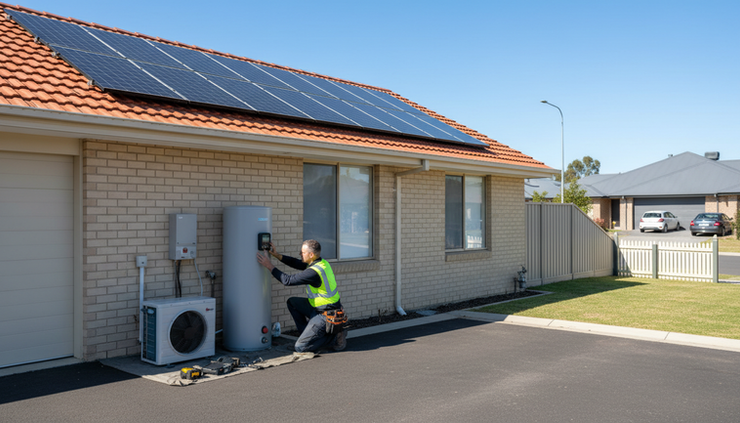
Set the timer to build a hot water buffer
A heat pump should not always run the same way a gas storage system did.
Gas systems often recover quickly. Heat pumps usually heat more slowly, but they use much less energy. That changes the best control strategy.
A practical approach is to heat the tank during the cheapest power window and store enough hot water for the evening and early morning.
For example:
A solar home may schedule heating from late morning to mid-afternoon
A home with cheap overnight power may schedule heating before morning showers
A home with a free electricity window may heat during that window first
A larger household may use a second short heating window if needed
Many households also benefit from heating the tank to a higher temperature during the cheap window. This creates a stored hot water buffer for overnight use.
This needs to be done correctly. Hot water delivered to taps must still be safe. Many systems use a tempering valve, which mixes hot water with cold water before it reaches taps. The installer should set the system so it stores enough heat while still delivering water at a safe temperature.
The timer should also allow for the system’s hygiene cycle if the model uses one. This is a normal high-temperature cycle that helps keep stored water safe. The installer can explain how the chosen model handles this and how it affects timing.
The goal is simple. Heat water when power is cheap, then avoid heating during expensive evening peak times unless the tank needs it.
Compare the Rinnai options by site, usage, and timing
A good selection process looks at the whole home, not just the model label.
Choice factor | 10A plug-in range | 15A dedicated-circuit range | Split system with separate heat pump unit |
Electrical work | Often simpler if a suitable power point exists | Needs its own circuit | Needs careful electrical and pipe planning |
Best fit | Many standard homes with moderate demand | Higher demand homes or planned electrical upgrades | Sites with space, airflow, or placement limits |
Installation location | Usually close to power and water connections | Flexible if a new circuit is run | More flexible tank and heat pump placement |
Usage pattern | Works well with smart scheduling | Suits larger loads and stronger recovery needs | Useful where airflow or noise placement matters |
Main check | Circuit safety and power point suitability | Switchboard capacity and cable route | Space, airflow, drainage, and service access |
A Rinnai hot water heat pump should be selected only after these checks. Choosing from a brochure alone can lead to the wrong tank size, poor timing, or electrical work that was not allowed for in the budget.
The better question is not “Which unit is best?” It is “Which unit fits this home, this switchboard, and this power plan?”
Work out the real running cost
The hot water heat pump running cost depends on three main items:
How much hot water the home uses
The efficiency of the selected system
The electricity rate at the time it runs
This is why two homes with the same unit can get different bills. One home may run the heat pump during a solar window. Another may run during the evening peak. The second home can pay much more for the same amount of hot water.
A simple running cost check should include:
Current gas hot water cost from bills
Look at annual gas usage, supply charges, and seasonal changes.
Current electricity tariff
Check peak, off-peak, shoulder, and any free power windows.
Solar export rate
If exported solar earns little, using it for hot water can be valuable.
Household hot water pattern
Evening showers need stored hot water ready before peak rates start.
Backup heating settings
Some systems have electric boost settings. These should be controlled so they do not run at expensive times unless needed.
Do not judge payback on the unit alone. The timer setup can change the result.

ROI comes from replacing gas and controlling when the heat pump runs
Gas storage hot water can be expensive to run. For many Melbourne households, typical gas hot water running costs are around $800 per year, depending on usage, gas plan, and system age.
A heat pump can reduce that cost because it moves heat rather than creating heat directly. The savings improve further when it runs during solar, off-peak, or free electricity periods.
A practical ROI example looks like this:
Item | Typical impact |
Existing gas hot water running cost | Around $800 per year |
Heat pump scheduled during cheap power | Lower annual running cost |
Solar used during the day | Better value from self-used solar |
Larger tank used as a buffer | Less heating during peak evening rates |
Estimated payback | Roughly 2.5 to 3 years in well-matched homes |
This is an estimate, not a fixed promise. Payback changes with installation cost, rebates if available, gas prices, electricity tariffs, solar size, and household water use.
The main message is clear. The best payback comes from a system that is sized correctly, powered safely, and programmed to heat at the cheapest times. A poor timer setup can leave savings on the table.
For a Melbourne home moving away from gas, the right heat pump can be a strong step. But the assessment needs to cover the switchboard, outdoor location, tank size, tariff, solar setup, and usage pattern.
Heataire can check those items before recommending a Rinnai option. For a practical, site-specific review, contact Heataire for a free Rinnai heat pump assessment.


Comments